
Health as a system: Why vitality factors are the key to energy, resilience and longevity
The EVER framework utilizes 25 measurable vitality factors for structured health optimization. Biomarkers enable targeted prioritization, from physiological foundations to complex systems, for evidence-based prevention and sustainable longevity.
 (1) (1).png)
Over the past ten years, our EVER co-founder Reiner Kraft, Ph.D., has intensively explored how to specifically strengthen and sustainably balance body and mind. In doing so, one thing became increasingly clear to him: health rarely fails due to a lack of knowledge, but rather due to a lack of structure and guidance. Too many approaches, too many recommendations – without a clear focus.
This work has resulted in a system of key vitality factors . We have now identified 25 of these, all relevant to prevention and longevity. These factors provide a common thread across all relevant areas of health, highlighting what is important and where individual focus should lie. Each vitality factor represents a clearly defined aspect of your health and is measurable via specific biomarkers. This allows you to maintain an overview, prioritize effectively, and work step by step on the areas that currently offer the greatest potential – without losing sight of other aspects. Based on this data-driven foundation, individual interventions can be precisely planned and sustainably optimized.
This framework offers therapists a clear, shared basis for their work: It transparently shows which topics are already being addressed, which areas are still open, and how the current status should be assessed – for example, using a simple traffic light system from red through yellow to green. This creates a structured, comprehensible approach that significantly facilitates therapy planning, communication, and progress monitoring.
But let's start from the beginning:
What is a vitality factor?
Vitality factors are measurable health aspectsthat significantly influence how well our bodies function – in terms of energy, resilience, and healthy aging. Each factor represents a clearly defined area, such as sleep quality, nutrition, cell membrane function, or mitochondrial performance. These factors can be measured using specific biomarkers and then targeted for optimization.
Essentially, vitality factors are not just individual aspects of health, but systemic building blocksthat interact with one another. If one is neglected, the entire balance of the body can be disrupted, leading to functional deficits and illness in the long term .
How do they build upon each other?
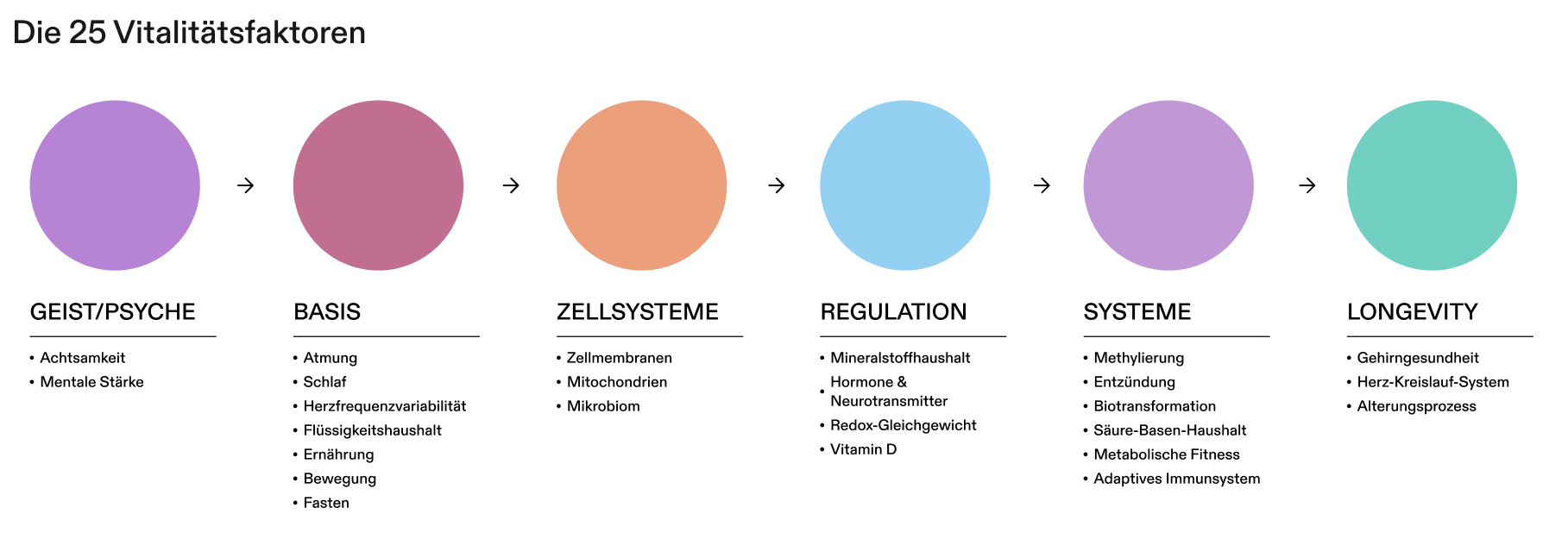
This horizontal representation of vitality factors consists of 6 levels that build on top of each other (from left to right) and can be interpreted as follows:
1. Fundamental physiological basic elements (left)
This section lists essential life processes such as:
- Mind
- Sleep
- Respiration & Water
- Nutritional status
- Heart rate variability
These are the basic conditionsunder which all other systems operate. Without stable basic functions, higher-level processes function poorly or not at all .
2. Cellular Systems and Regulation (Middle)
These are followed by factors that, while building on the basic elements, already involve a stronger degree of regulation and adaptation , for example:
- Cell membranes
- Mitochondria (energy production)
- Gut & Microbiome
- Mineral balance
These systems are sensitive and require that the basics are functioning before they can be optimized for performance.
3. Complex system states & performance metrics (right)
At the end of the chain are factors that reflect overall health and performance :
- Methylation (epigenetic regulation)
- Inflammation
- Adaptive immune system
- Metabolic fitness
These build upon all previous levels and are only stable, measurable, and modulatable once the basic and intermediate systems are solid.
In short, the horizontal representation of the levels shows that health does not arise in isolation, but rather in an ordered system sequence: first physical foundations → then energy and regulatory processes → finally complex integrative functions .
Impact & Benefits in Practice
At EVER, the vitality factors offer a concrete structure and operationalizability for prevention and longevity:
- Measurability & Clarity: The defined vitality factors allow users to see where they stand – e.g., specific biomarkers for sleep, mitochondrial function, or inflammation.
- Prioritizing measures: The horizontal model helps to prioritize interventions – improving basic factors first before pursuing advanced strategies.
- Personalization & Tracking: Heart rate variability, methylation status or microbiome balance can be displayed as performance metrics in EVER dashboards and tracked over time.
- Systemic framework: The vitality factors provide a sound framework for assessment, diagnosis and intervention.
- Evidence-based intervention recommendations: For each factor, established interventions exist (diet, fasting, sleep optimization, dietary supplements, etc.) which can be operationalized via EVER protocols.
- Holistic case conceptualization: The progressive structure enables coaches to recognize cause-and-effect chains and to guide patients/coachees through improvement phases in a structured manner.
Conclusion
Vitality factors are more than just individual health metrics – they are a systemic modelthat shows how physical, energetic and regulatory processes interact and how they specifically optimized .
The horizontal representation from left to right illustrates the logical sequence of structure and dependencies between basic, energy/regulation and performance/competence systems.
For EVER, this model provides a robust framework for measuring, prioritizing, and personalized optimization of health – supported by data-driven interventions and clear progress metrics.
 (1).png)
.png)
.jpg)