Quite tedious: Everyday life in functional medicine
EVER simplifies the creation and management of complex nutrient protocols and saves therapists time.
.jpg)
More and more doctors and therapists are turning to functional medicine and “prescribing” dietary supplements (DS) to their patients or clients
The reason for this is simple:
Vitamin, mineral, or amino acid deficiencies are widespread today , and addressing these deficiencies can significantly influence the healing process. In many cases, chronic illnesses can even be cured without the need for medication.
That's a great thing!
But there's a catch:
If a therapist wants to properly address the nutritional deficiencies of their patients or clients, they quickly find themselves dealing with 20, 30, or even more products.
An example illustrates this:
For a proper basic protocol, the focus is first on essential macronutrients. This typically requires 5-7 different fatty acids and phospholipids. These are complemented by several products containing proteins, amino acids , and nucleotides. Only then do you address the micronutrient supply of important minerals, trace elements , and vitamins. Especially at the beginning of therapy, it's crucial to specifically address any nutrient deficiencies. Additional products are then added for this purpose. Anyone already using this approach knows what I'm talking about.
How can you create a clean protocol under those circumstances?
Furthermore, dosage recommendations are not simply given arbitrarily, but are generally based on measured values (functional biomarkers). However, "measured values" is a flexible term these days, because in addition to classic blood analysis in a laboratory, functional medicine practitioners have a variety of other measurement methods at their disposal, such as laser spectroscopy (which I also regularly use as part of my preventative health check ).
All these different values should be recorded somewhere, ideally in such a way that time series can be created, so that it is possible to see at a glance how the situation of the patient or client develops over time.
What does my daily routine in epigenetics practice look like so far?
I always start with a comprehensive epigenetic history, during which the client also has ample opportunity to speak. This is usually followed by a preventative health check, allowing me to immediately identify specific deficits and areas for intervention. It's not uncommon for this process to take up to 1.5 hours!
Then I create an initial protocol, usually by hand on a sheet of paper. This can easily result in 10 to 15 products , and clients are often quite surprised by everything they're supposed to be taking!
I can provide many of these items directly to the client from my longevity shop . But of course, this also needs to be billed, so I have to enter each product into the shop's point-of-sale or booking system again.
It quickly becomes apparent that this initial protocol isn't ideally structured for the clients, as they prefer a clear overview of what they need to take in the morning, at midday, and in the evening. However, my sheet doesn't provide that, because I'm basing my approach not on times of day, but on illnesses and test results!
It becomes even more complicated when clients are already taking products. Often, these are not just medications, but also dietary supplements. I therefore have to adjust my protocol to avoid unnecessary duplication or overdosing individual active ingredients. This easily takes me another half hour.
And naturally, these protocols become more complex over time:
The results from laboratory tests (blood or DNA tests) must also be taken into account.
In chronically ill people, this can easily result in a total of 30 to 35 individual nutrients.
The rule is: 5 to 6 in the oil category, 4 to 5 for proteins/amino acids, 5 to 7 for nutrient deficiencies, and so on. Basics like vitamin D are also included. Only then are other nutrients with therapeutic effects introduced. My Longevity Protocol, outlining the general framework.
With three to four clients per day, I'm already completely booked up. Besides the protocols, I also take extensive notes for each client (in my word processing program, usually Google Docs) and enter all lab results and other measurements there.
Is there an easier way?
In the future, EVER 's software will support both therapists and patients. As a therapist, I will use EVER on my desktop computer, where I can directly enter measurements and create the report based on them.
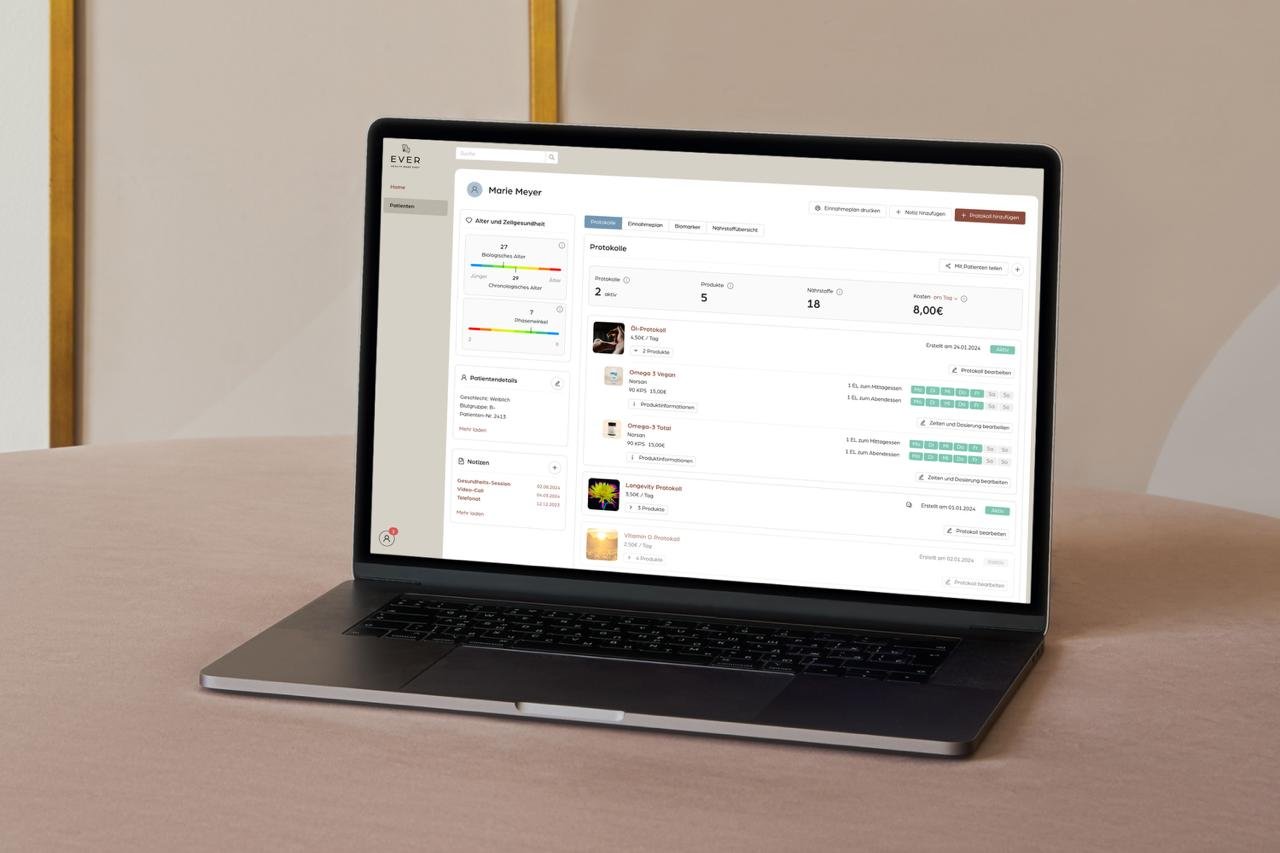
Maintaining an overview of complex nutrient protocols:Modern functional medicine practitioners sometimes use more than 10-15 different nutrient products. EVER helps you maintain an overview and saves time when creating and managing these protocols.
For specific areas, such as certain disease patterns, EVER will already have protocol suggestions in its database. This significantly speeds up the process because a basic framework is already provided and only needs to be individually adapted.
In this way, a first, completed protocol is created during the initial consultation with the client.
There's also a client-friendly version of this, automatically generated by EVER. This allows the client to see at a glance what they need to take in the morning, at noon, and in the evening. They can also use the EVER app on their smartphone to set reminders! All they need to do is download the app to their device, register, and log in.
Hopefully, this will save me, as a therapist, a lot of follow-up questions!
Additionally, my longevity shop will be integrated, allowing clients to order products there. The therapist can also register in the shop themselves, so they will receive a share of the corresponding commission on their patients' or clients' orders.
Far from being a hassle: EVER makes our lives easier
Overall, EVER will save us therapists a lot of time , simplify the creation of nutrient protocols , and allow us to clearly record measurements from different sources in one place . This will ultimately give us greater transparency and reduce errors.
Are you a functional medicine therapist yourself and do you use a similar approach? Now is also the time for feedback and feature ideas!
A first test version will be available for therapists starting in April, and you can register for the early access version here .
 (1).png)
 (1) (1).png)
.png)