Why we developed EVER Precision
Three problems plague personalized longevity practice: missing data, complex interpretation, and difficult implementation. EVER Precision combines DNA, proteomics, and lifestyle analysis into an integrated system
Three key problems in personalized longevity practice – and a new approach to solving them
A scene I encounter time and again in my work as a longevity coach: Someone comes to me with a bag full of supplements – ten, twelve containers, bought based on recommendations from podcasts, articles, and friends. The question is always the same: "Do I really need all this?"
The honest answer is usually: You can't say that, at least not without data.
A central component of my work involves personalized lifestyle and nutrient protocols. However, in practice, three fundamental problems have repeatedly emerged that hinder the development of a truly precise health strategy:
A reliable assessment of the body. The meaningful interpretation of the data. And its practical application in everyday life.
These challenges ultimately led to the development of EVER Precision, a system that addresses precisely these three points.
In this article, I would like to talk less about the product and more about the problems we have observed in recent years and how we have tried to solve them systematically.
Problem 1: A precise inventory of the body
When working with personalized health strategies, it all starts with a simple question:
Where does the body currently stand?
Many approaches in the field of longevity attempt to answer this question using individual measurement methods: blood tests, lifestyle questionnaires, DNA tests, wearables, functional biomarkers. Each of these methods provides valuable information, but none alone is sufficient to obtain a complete picture.
The role of genetics
An important component is the genetic blueprint. DNA determines the fundamental structure of various metabolic pathways: detoxification systems, energy metabolism, inflammation regulation, neurotransmitters, and micronutrient utilization.
You can think of it like the circuit diagram of a complex system. When you build a building, you need to know: where the wiring runs, what safety devices are in place, how the structure is built. Genetics plays precisely this role in metabolism.
The problem: The market for lifestyle DNA tests has become extremely confusing. There are many providers with very different approaches, which is more confusing than helpful for many people.
Therefore, we are currently developing a DNA test with a very clearly curated selection of genes that specifically targets the most important systems of cell metabolism.
The current state of the body
However, the genetic blueprint is only half the story. Between blueprint and reality lies what we call lifestyle and environment: diet, stress, sleep, exercise, micronutrient status, and environmental factors. These factors continuously alter the state of our metabolism.
To capture this condition, we have developed a comprehensive lifestyle questionnaire that specifically targets functional relationships within the body.
One example is mineral balance, which is often very clearly reflected in certain bodily functions. Questions about muscle regeneration, energy levels, or stress resistance can provide clues to possible imbalances and help to identify individual patterns.
The crucial point is this: These questions are not chosen randomly, but are based on functional relationships in metabolism.
Why proteomics is a game changer
One of the topics that is fundamentally changing personalized medicine is proteomics.
While genetics describes the blueprint, proteins show what is actually happening in the body. Proteins are the active molecules in metabolism. Among other things, they control: enzymes, transport processes, cell communication, inflammatory responses, and energy production.
DNA describes possibilities – proteins show the current reality.
That's what makes proteomics so exciting. In various tests, I've observed that many results correlate very well with other functional methods, such as laser spectroscopy analyses. In some cases, the findings even go significantly beyond them.
Another advantage is that modern proteomics tests can be performed non-invasively and at the same time provide a large number of functional biomarkers.
When you consider the costs, it also becomes interesting: A comprehensive functional blood panel with 50–60 biomarkers can quickly cost 600–800 euros. A proteomics test often provides significantly more systemic information at a lower cost.
Problem 2: What do you do with all this data?
Even with a good inventory, one central question remains:
How do you translate this data into concrete strategies?
In recent years, I have guided many people in developing individual nutritional and lifestyle protocols. A clear pattern has emerged: the body does not function in isolated individual substances, but in complex systems.
Therefore, I generally prefer to work with synergistic nutrient combinations rather than with isolated individual substances.
To better structure these relationships, I developed a model that I call the 25 Vitality Factors. This model systematically categorizes various metabolic areas, for example: energy production, stress regulation, detoxification, immune system, cell protection, and hormonal balance.
Nutrients are not considered in isolation, but rather evaluated according to which functional systems they support. This results in a structured, data-driven system.
The role of AI in this process
As the amount of data increases, another challenge becomes apparent: the interactions between nutrients are extremely complex. This is where AI can be very valuable.
The EVER AI helps, among other things, to: analyze nutrient interactions, detect potential interactions, check drug interactions, and identify patterns in large datasets.
Nevertheless, one important insight remains: AI does not replace experience.It can provide support, structure, and analysis, but ultimately, experts are needed to assess whether a protocol is truly useful.
Problem 3: Implementation in everyday life
Even the best strategy is of little use if it is not implemented in everyday life. Many people fail not because of a lack of knowledge, but because of complexity.
Typical problems include: too many supplements, unclear protocols, lack of structure, and insufficient documentation.
Therefore, we tried to radically simplify the implementation.
Two apps – one for therapists and one for users
A key component of EVER Precision is its software infrastructure. There are two main applications:
The EVER app for therapists enables experts to create individual protocols, evaluate data in a structured manner, securely document recommendations, and work in compliance with GDPR.
The EVER app focuses on providing users with a clear daily structure: what to do in the morning, what's relevant during the day, and what provides support in the evening. The idea is not to provide more information, but rather clear routines
Supplement packs instead of supplement chaos
Another component is something very practical: pre-packaged supplement packs.
Many people today have a whole collection of dietary supplements at home. This often leads to confusion, inconsistent intake, and unnecessary complexity.
Our solution is a simple system: morning, evening, before bed. The supplements are already portioned and can easily be used on the go.
EVER Precision: One system instead of individual tools
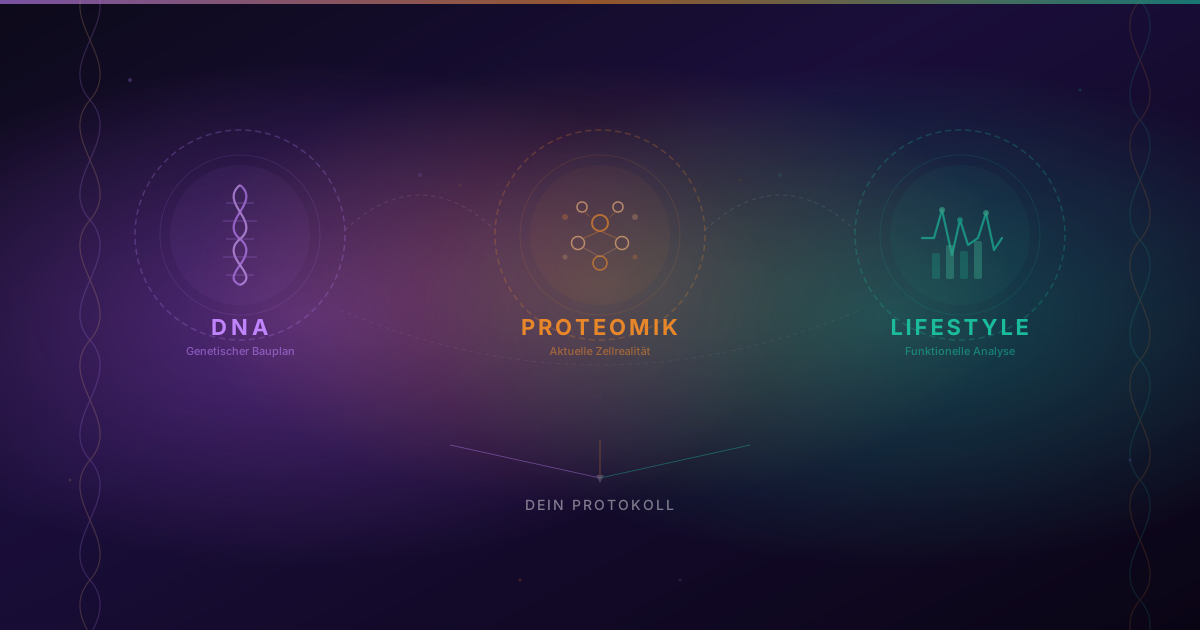
EVER Precision was born out of all these observations. The idea is not to offer yet another individual analysis, but an integrated system that connects multiple levels:
Genetics: the blueprint of metabolism. Proteomics and lifestyle analysis: the current state. Structured protocols: based on functional systems. AI-supported analysis: to aid data interpretation. Apps and routines: for practical implementation. Supplement packs: for simplification in everyday life.
The aim is to show that with targeted analyses and relatively little effort, one can learn a great deal about the state of one's own body and derive effective, everyday-use strategies from it.
The future of personalized longevity
Longevity medicine is currently moving from a simple concept – “Which supplements should I take?” – to a much more precise question:
What does my body need, based on data?
Genetics, proteomics, lifestyle analysis and AI make it possible for the first time to answer this question systematically.
The most exciting part, however, lies not in the technology itself, but in how we translate these insights into simple, practical routines.
Because in the end, it's not the analysis that decides our health, but what we actually do every day.
Want to know what your body really needs? You can find all the information about EVER Precision – DNA and proteomics analysis, personal consultation, and your individual supplement protocol – on our Precision page.