How good is your dietary supplement really? Why we at EVER have built an objective rating system
The EVER Guide objectively evaluates dietary supplements across five quality dimensions, revealing which products truly demonstrate their quality instead of merely claiming it.
Go to any online pharmacy and search for a simple magnesium supplement. You'll get hundreds of results. Different forms, different brands, different promises, and prices that vary tenfold. Which one is actually good? The honest answer is uncomfortable: It's almost impossible to tell just by looking at it.
This is not a fringe issue. The European market for dietary supplements is estimated to reach around US$49 billion by 2025 and has been growing at a high single-digit percentage rate for years (Grand View Research). Estimates from various market researchers differ, but they all point in the same direction: a huge, rapidly growing market with thousands of products that is practically exploding. For you as a consumer, this means one thing above all: ever more choice and ever less guidance.
Why I take this problem seriously
I've been working with dietary supplements for years. Not just theoretically, but daily in my epigenetics practice in Lahnau, where I use them as part of specific protocols. So I see firsthand what a well-formulated, cleanly manufactured product can achieve, and I also see how big the difference can be between two products that look almost identical on the label.
One conviction drives all my work: A good system is essential, and measurement is the foundation of everything. Anyone wanting to improve their health needs reliable building blocks. But this is precisely where I repeatedly encounter the same hurdle. Which products are truly high-quality, and how can I recognize them without believing marketing hype?
Anyone who wants to answer that seriously has to work their way through the manufacturer's website. And that's considerably more complex than it sounds.
The real problem: separating marketing from genuine substance
The hardest part isn't finding information. The hardest part is distinguishing verifiable claims from attractive packaging. When I read product pages, I keep encountering the same patterns:
- Certificates are claimed but not substantiated. It states "produced according to GMP," but proof, a test number, or a PDF is missing.
- "Laboratory tested" without specifying which laboratory, parameters, and batch were tested.
- Marketing terms like "premium", "highest purity" or "clinically researched" without any verifiable substance behind them.
- Active ingredient forms and dosages that remain unclear or disappear into the fine print.
- Studies that are cited, but refer to a single ingredient and not to the finished product.
- Certificates of analysis (COAs) are rarely publicly available and almost never batch-specific.
- Information is scattered across FAQs, the quality page, and the "About Us" section, making it difficult to find.
- There is no comparability between brands because each brand communicates differently and emphasizes different things.
It's perfectly clear that there are reputable manufacturers who honestly and thoroughly document their quality. They exist, and they deserve recognition. Nevertheless, a real challenge remains for the individual consumer: they would have to conduct a bit of research for each product, understand technical terms, and still ultimately make a guess. This takes time, which hardly anyone has, and requires knowledge that would first have to be acquired.
At this point, I asked myself the crucial question: Can we do this better? Not based on gut feeling, but algorithmically, objectively, and transparently, so that in the end there is a comprehensible evaluation instead of just a good feeling.
Our answer: the EVER Guide
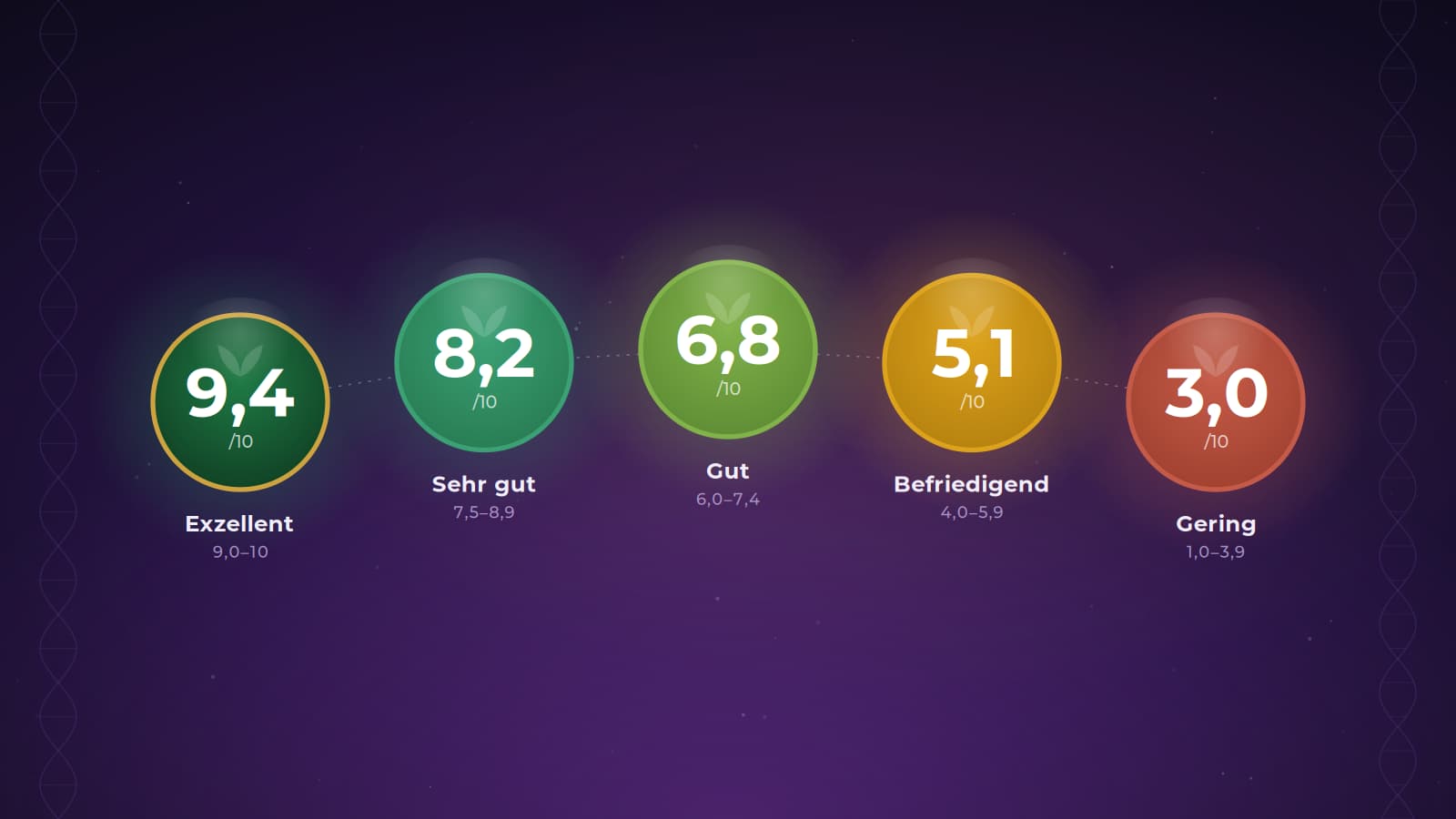
A few months ago, we at EVER started developing an AI for precisely this purpose. We call it the EVER Guide. Its task is clearly defined: It researches publicly available product and quality information about a brand, assigns the evidence to the correct quality categories, and ultimately assigns a rating on a scale of 1 to 10.
To ensure that the result is fair and reproducible, the EVER Guide looks at five dimensions that together accurately reflect the quality of a dietary supplement:
- Manufacturing – how and where is it produced, and how transparent are the standards?
- Testing and analysis – is testing carried out independently, and are the results accessible?
- Formulation and ingredient quality – sensible active ingredient forms, clean formulation, clear declaration?
- Scientific evidence – how well is the effect supported by reliable sources?
- Innovation and practical relevance – is the product well-designed and practically applicable?
One principle is particularly important to me, and it is deliberately strict. We evaluate documented quality, not claimed quality. If evidence is missing or a statement remains unclear, this leads to a deduction, not a favorable assumption. In cases of doubt, we therefore evaluate conservatively. This may seem harsh, but it is the only way to truly reward transparency and debunk marketing promises.
We are currently in the testing phase, evaluating our more than 2,600 dietary supplements one by one. This is intentionally a slow process. We want to test the system with real products, identify weaknesses, and refine it before rolling it out widely.
An example: MoleQlar Astaxanthin
To give you a better idea, here's a product review. MoleQlar's astaxanthin capsules achieved a score of 8.52/10. The product impressed across all five dimensions, particularly in manufacturing and testing.
Summary:
Moleqlar's astaxanthin capsules are characterized by a high level of manufacturing and testing quality, coupled with exceptional ingredient transparency and a formulation based on a well-established antioxidant. The product is supported by robust human studies at the individual ingredient level and is clearly focused on longevity and cellular protection.
What's convincing:
- Manufacturing takes place under GMP conditions with ISO/IEC 17025-certified laboratory testing by third parties. Documentation is provided at the brand level.
- Each batch is tested for identity, purity, and safety (including heavy metals and impurities). The corresponding certificates are publicly available.
- The formula contains highly purified astaxanthin (8 mg per capsule) from Haematococcus pluvialis, a well-researched and bioactive source.
- It contains no unnecessary additives; the ingredient list is clear and complete.
- The scientific basis is based on extensive human studies on the antioxidant and cell-protective effects of astaxanthin.
- The product is optimally integrated into modern programs for promoting longevity and cell health and has a clearly defined use case.
Where there is room for improvement:
- This product references publicly available, batch-specific Certificates of Analysis (COAs) or downloadable laboratory reports, but does not link directly to them.
- No product-specific clinical studies are cited; the scientific basis is primarily based on established findings at the ingredient level.
- No explicit sustainability or organic certification is documented for this product.
This case nicely illustrates how the system works. A high score is achieved where quality is not only present but also documented, from production processes to batch-by-batch laboratory testing. Even a strong product can still improve, for example, with readily available downloadable certificates or product-specific studies. The rating highlights precisely this difference: between "We do it well" and "We provide comprehensive proof that we do it well.".
What this means for you, for experts, and for manufacturers
For you as a reader, the goal is simple. You should be able to see at a glance how well-documented and thought-out a product is, without having to become a detective yourself. One score, five comprehensible dimensions, clear strengths and weaknesses.
For our EVER experts—doctors, naturopaths, therapists, and coaches—the benefits run even deeper. Anyone developing a nutritional therapy constantly makes product decisions, and the product's quality significantly impacts the outcome for the client or patient. This is precisely where the rating provides an objective factual basis that previously required painstaking research. At a glance, it becomes clear which products can genuinely demonstrate their manufacturing and testing, where the formulation is sound, and where the evidence falls short. This saves research time, makes product selection transparent, and allows for targeted selection of products that deliver on quality. Thus, recommendations to clients become not a matter of trust, but a decision that can be transparently justified.
For manufacturers, the message is just as clear, and it's good news. The path to a better score doesn't lie in better marketing, but in greater transparency. Those who make GMP certificates visible, publicly link batch-related certificates of analysis, and clearly explain their active ingredient logic will be rewarded in our system. Demonstrated quality beats merely claimed quality.
We are still at the beginning of this journey, and we learn something new with every product we review. But we're headed in the right direction. An objective, transparent, and reproducible evaluation provides precisely the guidance that has been missing in a market with thousands of products.
More on this as soon as we can share the next results from the testing phase.
Your,
Reiner
Dr. Reiner Kraft is a co-founder of EVER and works in his epigenetics practice in Lahnau with dietary supplements as part of individual health protocols.
References
- Market size Europe: Grand View Research – Europe Dietary Supplements Market
- MoleQlar Astaxanthin: moleqlar.com – Astaxanthin capsules